Not motivation.
Not hype.
Clarity.
It started with something embarrassingly small.
I was three sentences into an email when I caught myself reaching for ChatGPT. Not for strategy. Not for code. Just… to finish a simple email. That moment landed like a quiet punch to the gut.
If I couldn’t write a basic email without AI, what exactly had I outsourced from my own brain?
So I ran an experiment.
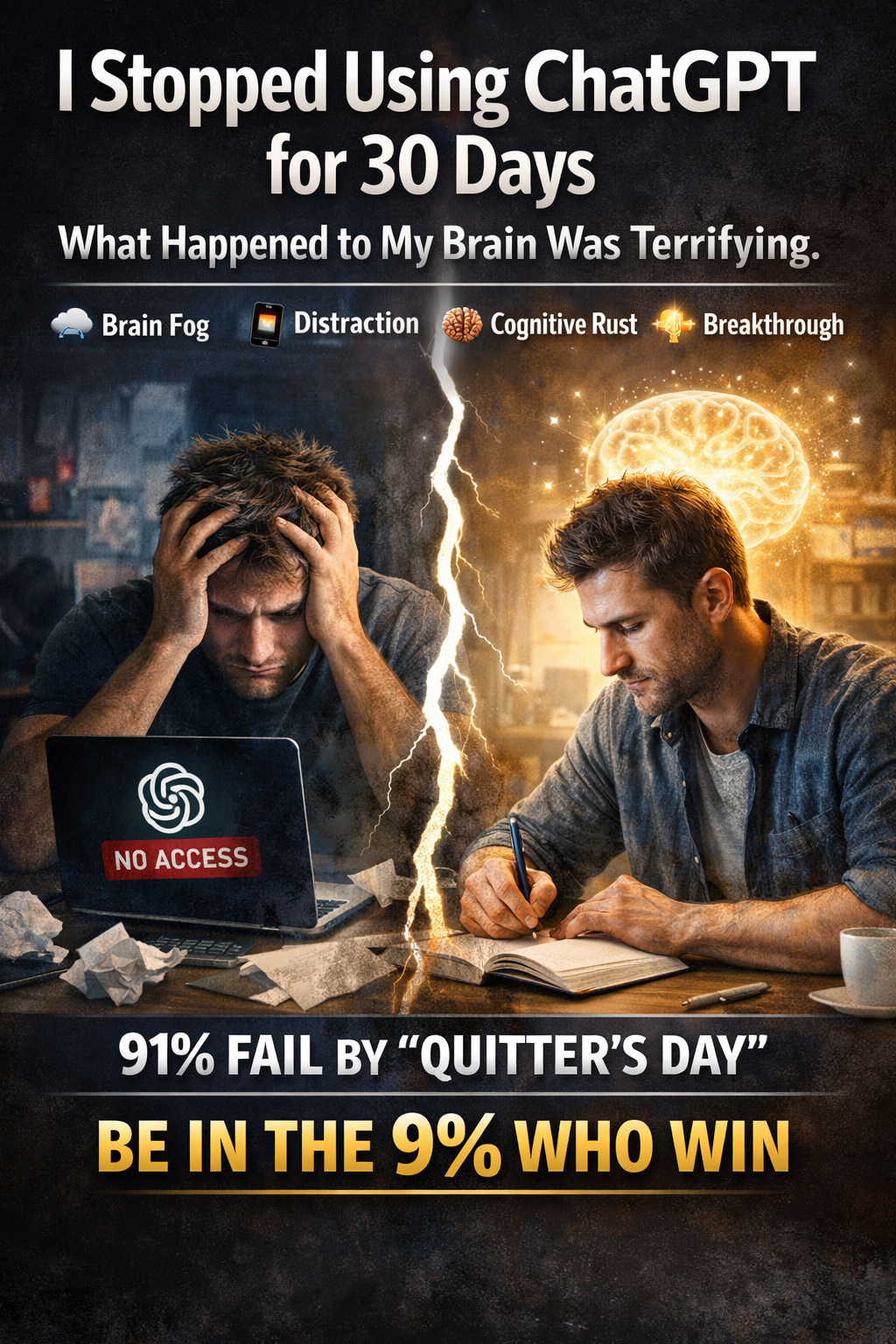
For 30 days, I cut myself off from ChatGPT and every AI shortcut I had quietly woven into my daily workflow. No rewriting. No idea generation. No summarization. Just me, a blank screen, and the same brain I’d spent years training—then conveniently outsourced to a server farm.
What happened next was terrifying. Then transformative. Then obvious.
Week 1: The Withdrawal
The first few days felt like quitting caffeine.
My thinking felt slow. My writing felt clumsy. My productivity dropped hard.
I’d open a document and just… stare at it. The words didn’t flow. The structure didn’t magically appear. I realized I had been using AI not as a tool, but as a cognitive crutch.
Instead of wrestling with ideas, I was delegating the struggle.
The most uncomfortable part wasn’t that I was slower. It was that my tolerance for mental discomfort had collapsed. The moment thinking felt hard, my reflex was to escape into automation.
And that’s a dangerous reflex.
Week 2: The Rust
By the second week, I noticed something unsettling.
My attention span was fractured.
Writing for 20 minutes felt exhausting. Reading long articles felt harder than it should. I had trained my brain on short, high-reward loops: prompt → output → dopamine. Now I was asking it to sit with ambiguity and effort again.
This is what “cognitive rust” feels like.
Not stupidity. Not burnout. Rust.
Skills that once felt sharp had gone dull from lack of use.
Week 3: The Rewiring
Then something shifted.
My thoughts started to organize themselves again. I began outlining before writing. I found myself pausing to think instead of rushing to produce. The friction didn’t disappear—but my tolerance for it grew.
Ideas became clearer because I had to hold them in my own head.
When you let AI think for you long enough, your brain adapts by doing less thinking. When you take that shortcut away, your brain slowly relearns how to carry cognitive weight.
This is neuroplasticity in action. Use it or lose it.
Week 4: The Quiet Confidence
By the final week, something unexpected happened: I felt calmer.
Not faster. Not more “productive.” Calmer.
There’s a strange peace that comes from knowing you can still think without outsourcing your mind. I wasn’t anti-AI by the end of the experiment. I was simply no longer dependent on it for first-pass thinking.
AI became a second brain again — not my primary one.
That distinction matters more than we’re willing to admit.
The Real Problem Isn’t AI. It’s Reflexive Outsourcing.
Let’s be clear: AI isn’t the villain.
Reflexive outsourcing is.
The danger isn’t that AI can write emails, summarize documents, or generate ideas. The danger is what happens when your brain never practices those muscles anymore.
We don’t lose skills overnight. We lose them through convenience.
And convenience is seductive because it feels like progress while quietly hollowing out our capacity to struggle, reason, and create.
Why This Matters Before 2026
In exactly three days, most people will set New Year’s resolutions.
By January 10th — a date researchers literally call “Quitter’s Day” — 91% of them will have already abandoned those goals.
Not because they’re lazy. But because their environment is engineered for cognitive ease.
We live in the easiest time in history to avoid effort:
- AI can think for you
- Algorithms can decide for you
- Feeds can distract you
- Automation can carry you
But winning has always belonged to the small percentage willing to tolerate friction.
The 9% who actually change aren’t more motivated. They’re more comfortable being uncomfortable.
How to Be in the 9% (Without Quitting Technology)
This isn’t a call to delete your AI tools.
It’s a call to use them deliberately.
Here’s the rule I follow now:
Think first. Augment second.
- Write the ugly first draft before asking AI to improve it
- Struggle with the problem before requesting solutions
- Generate your own ideas before optimizing them
Use AI as leverage, not life support.
The Easiest Time in History to Win
Paradoxically, the same tools that make thinking optional make disciplined thinking incredibly rare.
That means the bar is lower than ever.
If you can:
- Focus for 30 minutes
- Write before prompting
- Sit with confusion
- Resist instant optimization
You’re already ahead of most people.
Not because you’re smarter. But because you’re practicing something most people have outsourced.
Three days before 2026, this is the quiet advantage no one is talking about.
The future won’t belong to those who use AI the most.
It will belong to those who know when not to.